

The foundation your shed sits on will determine how long it lasts, how well the doors and windows function, and whether moisture becomes a problem over time. Get the base right and the shed takes care of itself. Get it wrong and you will spend years correcting the consequences.
This guide covers every common shed base option available in the UK — what each involves, what it costs, where it works well, and where it falls short. By the end, you will know which option suits your garden, your shed, and your budget.
What Makes a Good Shed Base?
Before comparing specific materials, it helps to understand what a shed base actually needs to do. A good base for any garden building must:
- Provide a level, flat surface across the full footprint of the shed
- Bear the weight of the building and its contents without settling or shifting
- Allow water to drain away rather than pooling beneath the structure
- Lift the shed floor off the ground to allow airflow and prevent damp
- Remain stable through seasonal ground movement caused by frost, rain, and drought
Any base that meets these five criteria will serve a shed well. The differences between options lie in how they achieve these outcomes, at what cost, with how much disruption, and for how long.
Option 1 — Concrete Shed Base
A poured concrete slab is one of the most widely used shed foundations and, when correctly installed, one of the most durable. It provides a rigid, level surface that will not shift with soil movement and can support heavy loads indefinitely.
The process involves excavating the soil to around 150mm depth, laying a compacted hardcore sub-base, adding a damp-proof membrane, and pouring concrete to fill the shuttered frame. The concrete must then cure for at least 48 hours before any load is placed on it, and longer in cold weather.
Concrete works well for large, heavy garden buildings intended as permanent structures — workshops, garden studios, and log cabins that will not be relocated. It is the preferred choice when the shed will house heavy machinery or be converted for habitable use.
The limitations are significant. Concrete requires extensive groundwork, a reasonable level of construction skill to lay well, and a period of unavailability while it cures. It is the most expensive base option on a per-square-metre basis, particularly when labour is included. On sloped ground, the complexity and cost rise further. And once poured, it is permanent — removing concrete is slow, expensive, and environmentally wasteful. If environmental impact is a consideration for your project, our guide to eco-friendly garden building foundations compares the footprint of concrete against lighter-impact alternatives.
Option 2 — Paving Slabs
Paving slabs offer a more manageable alternative to poured concrete for lighter garden buildings. Individual slabs are bedded on a prepared layer of sharp sand or compacted hardcore and levelled individually across the footprint.
The result is a stable, level surface that handles moderate loads well. Drainage is better than a solid concrete slab, as water can pass between the slabs rather than running off the surface entirely.
Installation requires careful preparation. Each slab must be individually levelled, and any unevenness in the underlying ground will compromise the result. On sloped ground, the groundwork required to create a level sand bed across the full footprint becomes progressively more involved. Paving slabs work well for smaller sheds on reasonably flat ground. For larger buildings or sloped sites, they become less practical.
Option 3 — Gravel and Timber Frame Base
A timber frame perimeter filled with compacted gravel is a practical and relatively affordable solution for smaller and medium-sized sheds. The timber frame defines the edge of the base, gravel is laid within it and compacted, and the shed floor sits on bearers running across the gravel bed.
This method provides reasonable drainage and the airspace between the shed floor and the gravel helps with ventilation. It is well suited to DIY installation and is considerably cheaper than concrete on comparable footprints.
The timber frame is the weak point. Pressure-treated timber is resistant to rot but not immune. Over a period of years, the perimeter frame will deteriorate, particularly where it is in contact with the soil. For a shed expected to last five to ten years, a gravel base is a sensible choice. For a structure intended to remain in place for twenty years or more, the gravel base will likely need attention before the shed itself does.
Option 4 — Plastic Grid Base
Plastic shed bases — interlocking grid panels laid over a weed membrane on prepared ground — have become a popular choice for residential sheds over the past decade. They are quick to install, require no groundwork beyond clearing and levelling the area, and can be taken up and relocated if the shed is moved.
Filled with gravel, the grid panels provide good drainage and a reasonably stable surface for lighter buildings. They are genuinely the most accessible DIY option for anyone without construction experience.
The limitations become apparent with larger or heavier structures. Plastic grid bases are not designed to carry the loads associated with garden offices, log cabins, or buildings that will house heavy equipment. Over time, the panels can flex and shift, particularly on ground that experiences seasonal movement. Plastic grids are an acceptable solution for tool sheds and small storage buildings on flat, stable ground.
Option 5 — Timber Bearer Base
Some sheds, particularly smaller and lighter models, are sold with their own floor unit that includes integral bearers. These run lengthways along the base of the building and are intended to sit directly on a level surface — prepared ground, paving, or a concrete slab.
If your shed is supplied with a floor unit with built-in bearers, those bearers should sit on a properly prepared base, not directly on the soil. Without a stable, level platform beneath them, bearers alone provide insufficient support and are highly susceptible to moisture damage where they contact the ground.
Option 6 — Ground Screws
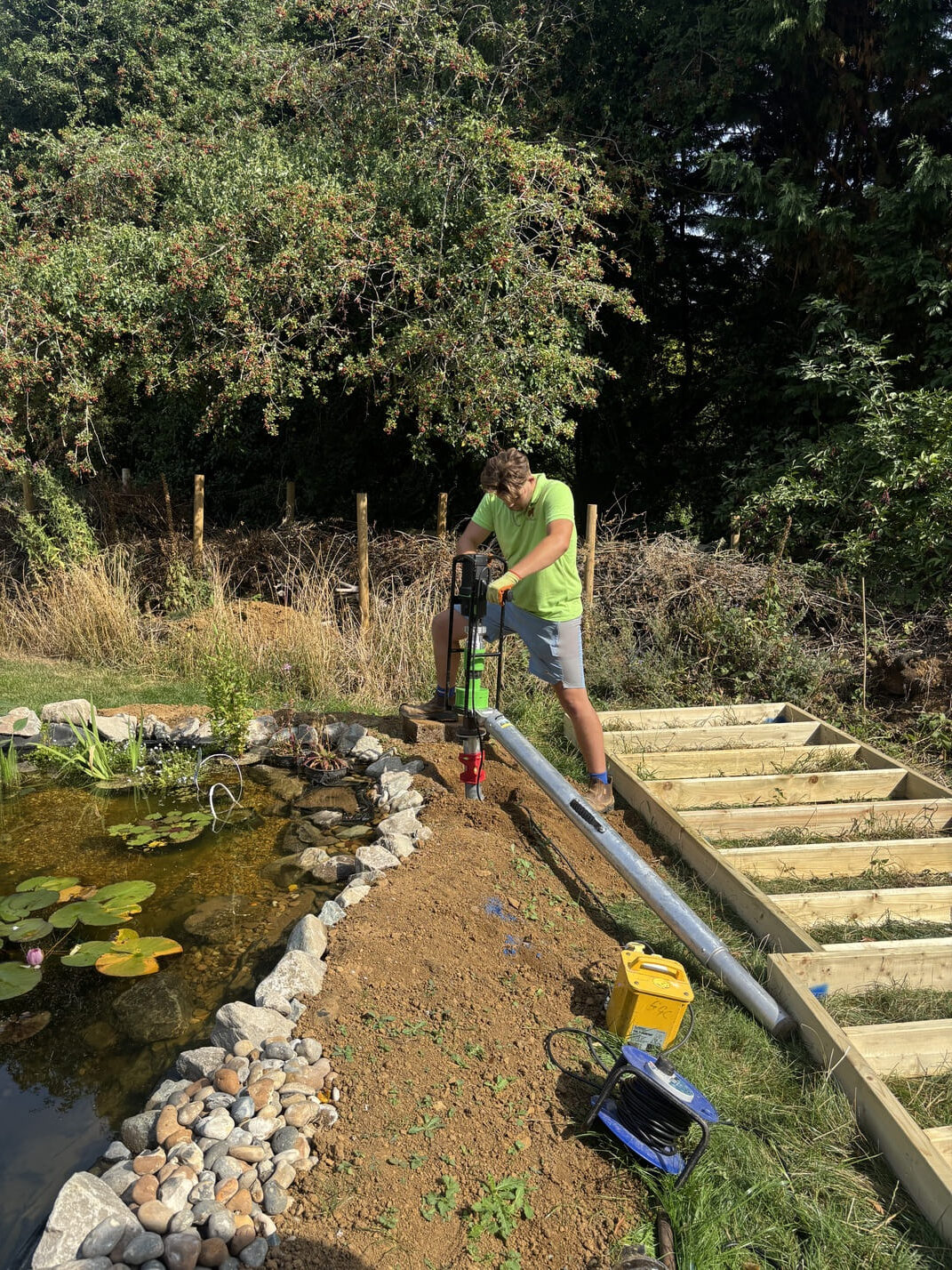
Ground screws are steel helical piles driven into the soil using specialist installation equipment. Each screw is adjusted to a precise height, creating a grid of level mounting points across the shed footprint. A structural timber frame is built across these points, and the shed is erected on the frame.
This approach is fundamentally different from every other method listed here. It does not require excavation, concrete, or any material being placed permanently in the garden. The screws go into the ground; nothing is removed or built up. The garden beneath the shed remains undisturbed.
The resulting base is mechanically stable in a way that gravel, paving slabs, and timber bearers cannot match. Because each screw is independently driven and adjusted, the base is precisely level regardless of the ground conditions beneath — including slopes, uneven terrain, and soft or variable soil. The timber frame sits above the ground surface, allowing airflow beneath the shed and eliminating the moisture contact that causes rot in ground-level bases.
Ground screws are reversible. If the shed is relocated, the screws can be extracted and the garden returns to its original state. No concrete pad, no hardcore, no permanent alteration to the land. Gorilla Base installs ground screw bases professionally across the UK, completed in a single day, with a lifetime warranty on all screws.
For full details on how ground screws work as a foundation system — including installation depth, soil compatibility, load-bearing specifications, and pricing — see our dedicated ground screws for shed base page.
The same system works equally well for garden decking — see our ground screws for decking page for full details on levelling decking frames across uneven and sloped ground.
For a full overview of our professional ground screw installations, visit our Gorilla Base ground screw range — including pricing, process, and warranty details.
Learn more about how ground screw foundations work as a permanent alternative to concrete bases.
Ground screws are equally well suited to larger structures. For a full breakdown of how they work as a garden room foundation, see our dedicated guide.
Best Shed Base — Comparison Table
| Base Type | Slopes | Install Time | Permanent | Airflow | Cost | Lifespan |
|---|---|---|---|---|---|---|
| Concrete slab | With difficulty | 2–3 days + cure | Yes | No | High | 25+ years |
| Paving slabs | Limited | 1–2 days | Removable | Minimal | Medium | 15–20 years |
| Gravel + timber frame | Limited | Half–1 day | Removable | Yes | Low–Medium | 10–15 years |
| Plastic grid | Flat only | 2–4 hours | Removable | Minimal | Low | 10–15 years |
| Ground screws | Yes | 1 day | Extractable | Yes | Medium | Lifetime warranty |
For a deeper breakdown of the two most popular options, see our ground screws vs concrete guide.
Which Shed Base Is Best for Your Situation?
Rather than a single answer, the best shed base depends on what you are building, on what ground, and for how long.
For a small garden storage shed on flat, well-drained ground where budget is the priority, a plastic grid or gravel base is a reasonable and practical choice. For a mid-sized shed on stable flat ground where you want a more permanent result, paving slabs or a gravel and timber frame base perform well.
For a large shed, garden office, log cabin, or any building expected to stand for twenty years or more, concrete remains the most durable option — but ground screws achieve comparable long-term stability with significantly less disruption and without the permanence of a concrete slab. If you are planning a garden office or studio rather than a standard shed, our guide to foundations for garden offices and studios covers the additional considerations for larger, more complex structures.
For a shed on sloped or uneven ground, ground screws are the most straightforward solution regardless of building size. They eliminate the need to level the site before installation, which is the main challenge and expense in all other methods on difficult terrain.
If your garden has a gradient or uneven terrain, the choice of base type matters even more. Read our dedicated guide on installing a shed base on a slope for a full comparison of methods and costs on sloped ground. We also cover the technical side of building foundations on uneven terrain, including drainage, levelling, and how to avoid excavation altogether.
Does a Shed Base Need Planning Permission?
In most cases, no. A shed base for a standard garden outbuilding is considered part of the structure itself for planning purposes and falls within the same permitted development rules as the building. Provided the shed meets the standard permitted development conditions — relating to size, eaves height, ridge height, and proximity to boundaries — the base does not require a separate application.
If the building is unusually large, close to a road boundary, or the property is in a conservation area, different rules may apply. The Planning Portal is the most reliable source of current guidance for England and Wales.
Frequently Asked Questions
Get a Professional Shed Base Installed
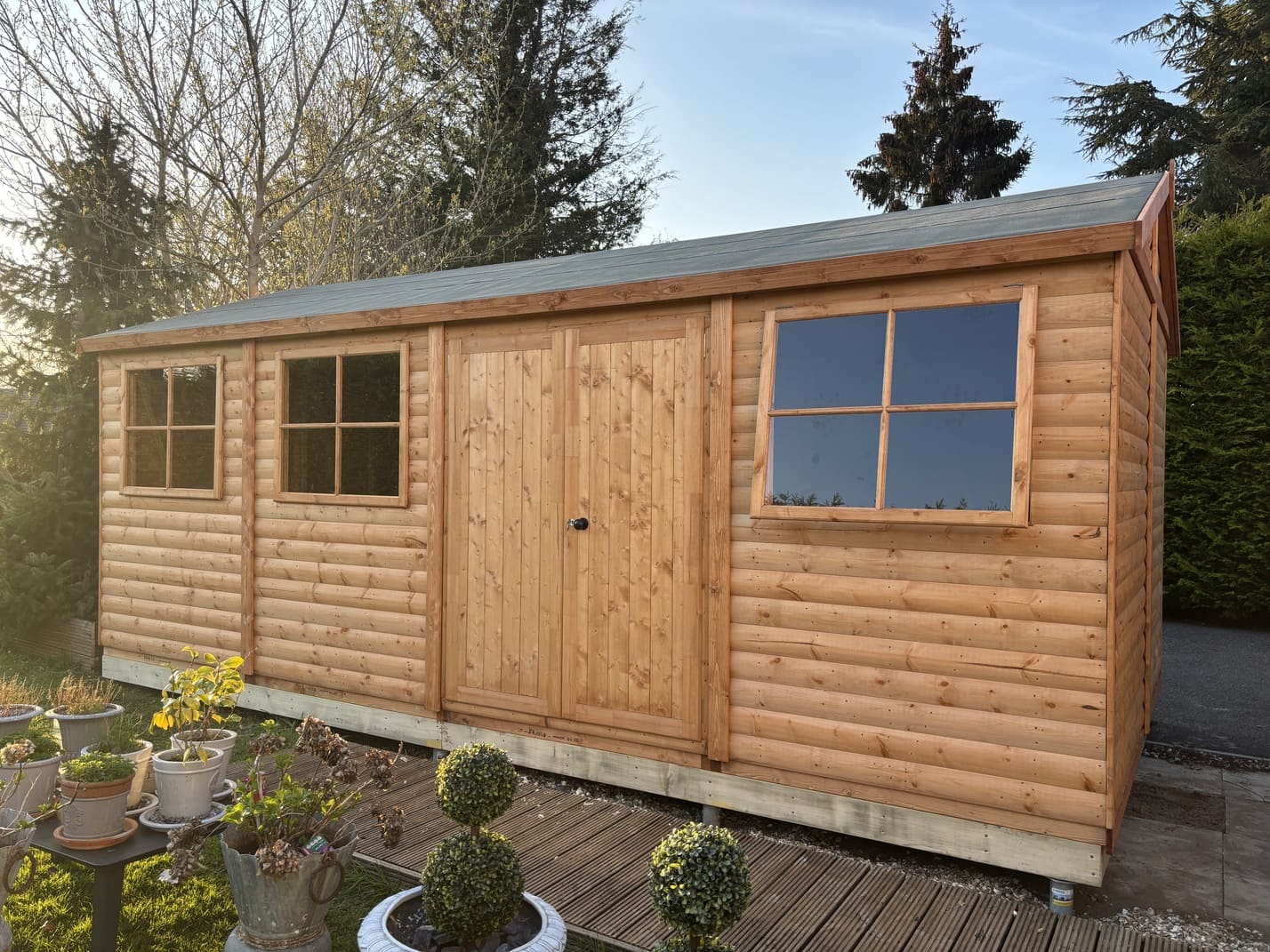
If you are planning a new shed, garden office, or any outdoor building and want a base that is professionally installed, ready in a day, and guaranteed for life, Gorilla Base provides ground screw installations across the UK. Tell us the size of your building and your location for a fixed-price quote.
Get a Free Quote