Choosing the right foundations for a garden office isn’t just a technical decision — it affects planning permission, drainage, thermal performance, and how long your structure actually lasts. Most buyers compare three options: concrete slab, paving slabs, or ground screws. Each has real trade-offs in cost, installation time, and reversibility. This guide breaks down what works — and what most suppliers won’t tell you.
A concrete slab is permanent, load-bearing, and familiar to most builders. For a 3×4m garden office, expect 3–5 days of groundwork plus 28 days curing time. Cost: typically £800–£2,000 for materials and labour. The main drawbacks: requires planning permission in some cases, cannot be reversed without significant excavation, and creates drainage problems if pitched incorrectly.
Paving slabs are a common DIY choice for sheds and smaller studios. They’re lower cost (£200–£600 for materials) but require a level, well-drained base. Slabs can shift over time, especially on clay soil or sloped gardens, leading to uneven floors and door alignment problems.
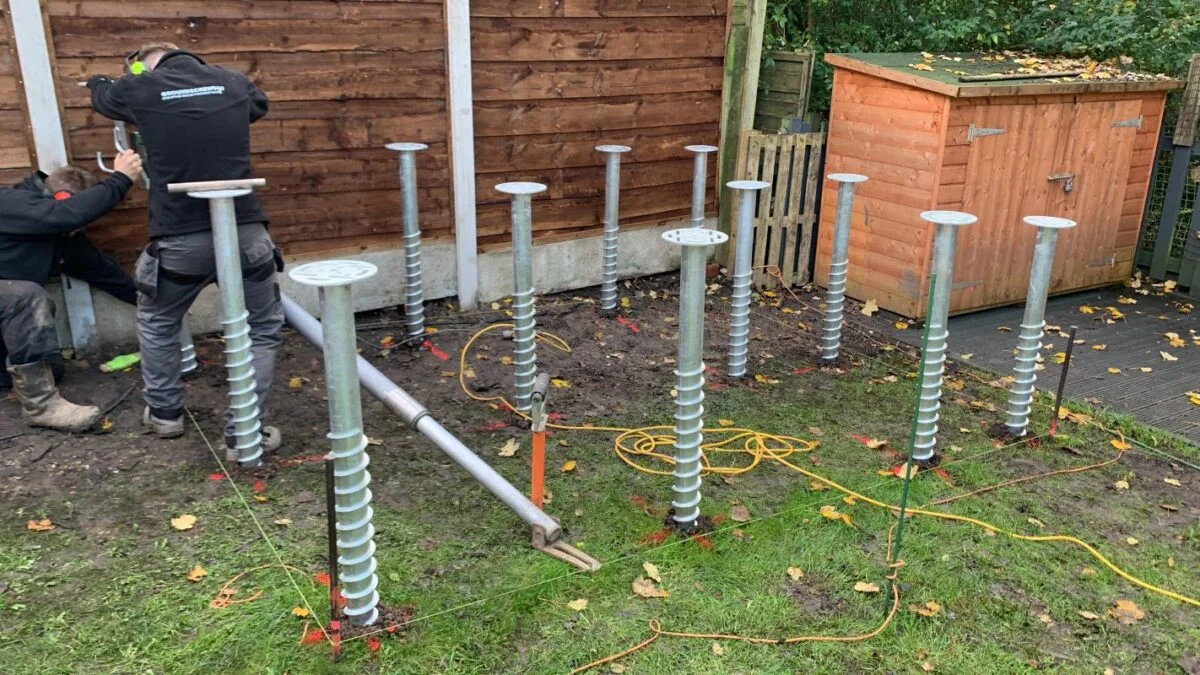
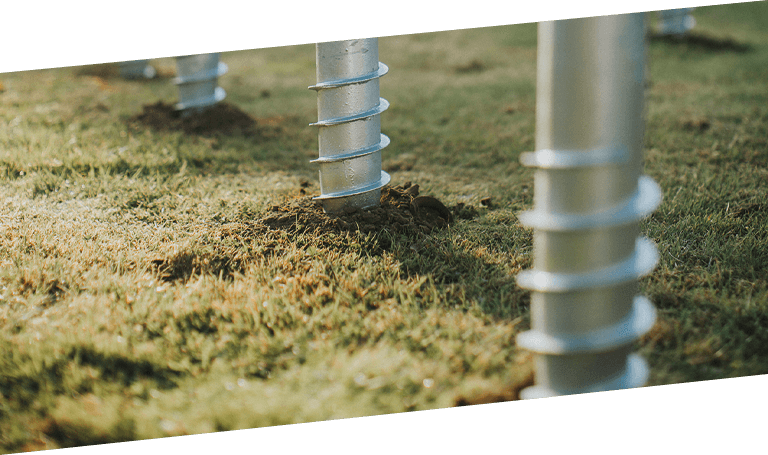
Ground screws are driven directly into the soil using specialist equipment — no concrete, no excavation, no curing time. A full foundation for a garden office or studio is typically installed in 2–4 hours and is ready to build on the same day. For garden offices housing electrics or computing equipment, the ventilated airspace underneath the structure prevents moisture ingress and condensation — a significant advantage over slab foundations.
Here’s how the two most popular options compare for a typical 3×5m garden office:
| Feature | Ground Screws | Concrete Slab |
|---|---|---|
| Installation time | 2–4 hours | 3–5 days + 28 days curing |
| Excavation required | None | Yes (150–200mm minimum) |
| Works on slopes | Yes | Requires significant groundwork |
| Reversible | Yes — screws out cleanly | No |
| Drainage impact | Minimal (permeable) | Impermeable — drainage required |
| Typical cost (materials) | £299 – £499 | £800–£2,000 |
| Load capacity | Up to 10 tonnes per screw | High (design-dependent) |
In most cases, ground screws for garden offices fall under Permitted Development rights in England and Wales, as they involve no permanent concrete footings. However, the structure itself may require planning permission depending on size, height, and proximity to boundaries. Always check with your local planning authority before installation. The Planning Portal (gov.uk) provides a self-assessment tool for garden buildings.
Ground screws are the strongest choice for garden offices and studios when speed, reversibility, and ground conditions matter. They’re particularly well suited to:
For straightforward flat gardens with no soil issues, a concrete slab remains a proven option — though the time and cost premium is significant. Paving slabs suit only the smallest, lightest structures.
Gorilla Base ground screws are engineered to BS EN ISO 4014 standards and carry a manufacturer’s 25-year structural warranty. Learn more about ground screws for garden rooms specifically, or get a free quote for your project.
For a typical garden office or studio, Gorilla Base ground screws are installed to a depth of 800mm–1200mm depending on soil conditions and the structural load. Our installation team assesses soil torque during installation to confirm each screw has reached adequate bearing capacity. Depth is always confirmed on-site, not predetermined.
Ground screws work in most UK soil types including clay, loam, sandy, and chalk soils. They are not suitable for solid rock or heavily compacted rubble. A preliminary soil assessment is recommended for sites with unknown ground conditions. Gorilla Base provides guidance on soil suitability as part of the free quote process.
The foundation itself (ground screws with no concrete) generally does not require planning permission under Permitted Development rights in England and Wales. However, the garden office structure above may require permission depending on its height, footprint, and proximity to boundaries. Check the Planning Portal or consult your local authority.
Installation of ground screws for a standard garden office (up to 6×4m) takes 2–4 hours. The foundation is load-bearing immediately — there is no curing time, unlike concrete which requires 28 days before building can begin. This makes ground screws significantly faster for project timelines.
Ground screws are fully reversible. They can be unscrewed and removed without excavation, leaving the ground virtually undisturbed. This makes them ideal if planning conditions change or if you want to relocate your garden office in future. Concrete slab foundations cannot be removed without significant demolition work.